Market Data & Analysis
View current cash bids, delayed pricing options, and discount schedules for corn and soybeans at our Union City location.
View current cash bids, delayed pricing options, and discount schedules for corn at our Colwich location.
Contract Options
Spot Sell (Cash Sale)
The “Right Here, Right Now” Option.
A Spot Sell is a simple transaction where you deliver your grain and price it immediately based on the elevator’s current daily cash price.
How it works: You bring the grain to the scale, and the price is set the moment you deliver (or shortly after the physical characteristics like moisture and grade are determined). Ownership transfers immediately, and payment is processed right away.
The Benefit: It is clean and simple. You get immediate cash flow, eliminate all future price risk, and avoid any storage or service fees.
The Risk: You take whatever the market is offering that day. If the market rallies next week, you don’t participate in that upside.

Forward Contract (Fixed Price)
The “Peace of Mind” Option.
A Forward Contract allows you to lock in the total cash price (both the futures and the basis) for a specific amount of grain to be delivered at a future date.
How it works: You agree today on the price you will receive when you deliver your corn or soybeans later (e.g., locking in a price in July for October delivery). This sets your “check price” in stone, regardless of what the market does between now and delivery.
The Benefit: Total price protection. If the market crashes before you deliver, your price is safe. It makes budgeting and cash-flow planning much easier because you know exactly what that grain is worth.
The Risk: You are locked in. If the market rallies significantly after you sign, you cannot participate in those higher prices. There is also a production risk—if a weather event prevents you from growing the grain, you are still obligated to fulfill the bushels on the contract.

Basis Contract
Lock in the “Spread,” Gamble on the “Board.”
A Basis contract allows you to lock in the difference between the local cash price and the futures market (the “basis”) but leaves the futures price open for later.
How it works: You “fix” the basis—which is great if local demand is strong—but the final check you receive will fluctuate based on how the Chicago Board of Trade (CBOT) moves. You’ll choose a futures month to track and must price the grain before that month expires.
The Benefit: Protects you from the local basis widening (weakening) while allowing you to benefit if the national futures price goes up.
The Risk: If futures prices fall, your final payout falls with them, regardless of how good the basis was.

Futures / HTA (Hedge-to-Arrive) Contract
Lock in the “Board,” Gamble on the “Spread.”
An HTA contract is the exact opposite of a Basis contract. You lock in the futures price on the CBOT but wait to set the local basis until a later date.
How it works: You secure a specific futures price for a specific delivery month. This “floors” the biggest part of your price. Before you deliver, you’ll need to “set the basis” to determine your final cash price.
The Benefit: Excellent for protecting yourself against a drop in the national market while giving you the flexibility to wait for local basis levels to improve.
The Risk: If local basis levels weaken (e.g., the elevator is full or there’s a rail backup), your final price could end up lower than expected even if the “board” stayed high.

Delayed Pricing (DP) Contract
The “Deliver Now, Price Later” Option.
With a Delayed Pricing contract, you deliver your grain to the elevator immediately but wait to set the final price. This is a popular choice when you’ve run out of bin space but think the market has room to move higher.
How it works: You transfer ownership of the grain to us upon delivery. You have a set window of time to “price” that grain based on the current cash price at the elevator.
The Benefit: You move the crop off the farm and avoid physical storage issues while keeping the door open for a market rally.
The Risk: You are fully exposed to price drops, and you’ll typically pay a monthly service fee (DP charges) until the grain is priced.

Minimum & Minimum/Maximum Price Contract
The “Protected Upside” Option.
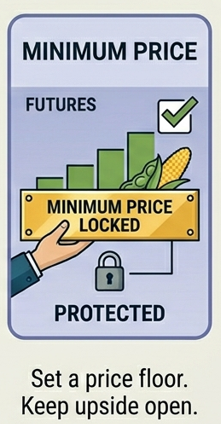
A Minimum or Min/Max Price Contract locks in a base floor price to protect you from market collapses, but leaves the door open to receive a higher final price if the market rallies.
How it works (Minimum Price): You establish a fixed floor price below the current market. You deliver your grain and receive an initial payment (often the floor price minus fees and the option premium). You are protected against any further price drops. If the futures market rises above a set trigger point before the pricing deadline, you will receive a secondary check for that price difference.
How it works (Min/Max Price): It is identical to a Minimum Price, but it puts a cap (ceiling) on the potential extra payment. By accepting a maximum potential price, you reduce or sometimes eliminate the option premium.
The Benefit: Maximum security with participation. You are guaranteed a minimum income, removing the fear of a total market collapse. Unlike a Forward Contract, you aren’t locked into a single number; if the market takes off, your income goes with it.
The Risk: Fees and opportunity cost. Minimum price contracts involve a premium (a per-bushel fee) for the “insurance policy” on the price. If the market falls or goes sideways, that premium was a cost with no return. With a Min/Max, you cannot participate in extreme rallies that exceed the ceiling. You still have production risk on the guaranteed bushels.
OTC - Accumulator Contracts
The “Custom-Built” Solution.
An OTC contract is a private transaction that allows you to customize your pricing strategy beyond the standard options. These often use professional “pricing structures” to help you hit a specific target or protect a specific margin.
How it works: Instead of just locking in a simple price, you work with us to set parameters. For example, you might choose an “Accumulator” contract that prices a set amount of bushels every day as long as the market stays within a certain range, or a “Bonus” contract that gives you a premium over today’s price in exchange for a firm commitment to deliver more grain if the market hits a certain level
The Benefit: Tailored strategy. It allows you to automate your marketing and potentially capture higher-than-market prices without having to watch the ticker every minute. It can be designed to perform best in “sideways” markets where traditional contracts struggle.
The Risk: These contracts have more “moving parts” (like knock-out levels or doubling features) that can be confusing if not fully understood.

Trading Tools & Portals

Login to your CIH Hedging account for the Union City facility. Access your grower portal and trading tools.
Login to your CIH Hedging account for the Colwich facility. Manage contracts, view positions, and execute trades.
Educational Resources

A comprehensive guide to futures trading from the National Futures Association. Learn about contracts, trading strategies, margins, and risk management.

Iowa State University Extension resource explaining common grain marketing terms and concepts to help you understand your options.

If you have questions about accessing any of these resources or need assistance with your account, please contact our support team.